Executive functioning

Executive Functioning

Executive (DYS)functioning: A Week of Meltdowns, Memory Lapses, and Mayhem
How Everyday Chaos Taught Me About the Brain’s Hidden Skills
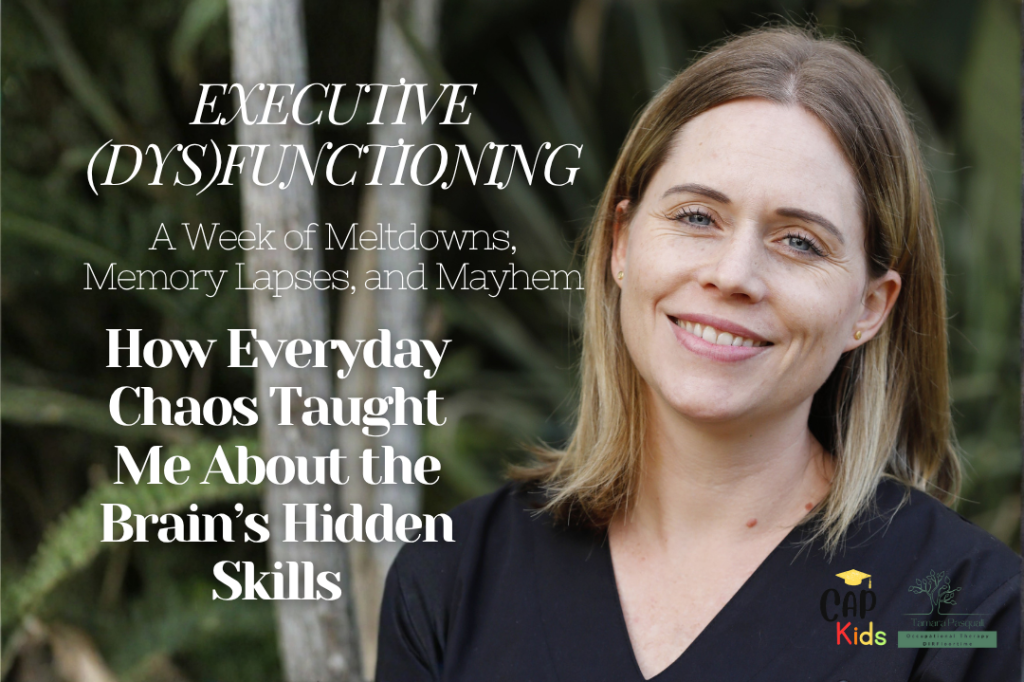
I am a mom of two boys first, and then I am an OT. It’s always a struggle between juggling these two hats, so believe me, we definitely don’t get it right in our house all the time. In the spirit of honesty (and humour), here’s a little snapshot of our executive (DYS)functioning in action…

by Tamara Pasquali

Executive (DYS)functioning: A Week of Meltdowns, Memory Lapses, and Mayhem
How Everyday Chaos Taught Me About the Brain’s Hidden Skills
Have you heard about executive functioning?
If your child is having play or occupational therapy, or if you’ve ever read up about ADHD, or autism, you may have come across this buzzword. And as “woke” as it may sound, it’s actually a real thing! And it’s something us occupational therapists know a thing or two about.
Full disclosure though: I am a mom of two boys first, and then I am an OT. It’s always a struggle between juggling these two hats, so believe me, we definitely don’t get it right in our house all the time. In the spirit of honesty (and humour), here’s a little snapshot of our executive (DYS)functioning in action (my kid’s names have been changed because I don’t trust the internet):

Monday:
Mom: “Luigi, please open the curtains and take your plate to the dishwasher.” Luigi: (walks halfway across the room) “Wait… what must I do again?” Working memory: offline.

Tuesday:
Fetched the kids from school. Usually, we go straight home, but today I needed to collect a parcel from Takealot. Mom: “Boys, we’re just making a quick stop at Takealot.” Daniele: “Nooo, Mom! We can’t! I neeeed to go home now!” Luigi: “But you said this morning we were going straight home! We always get home by 2:30 pm. How long will it take us now? I won’t have time to do all my things!” Cue moaning, negotiation, and one-and-a-half meltdowns. Cognitive flexibility? Still buffering.

Wednesday:
Mom: “Daniele, are you ready for your exam tomorrow? Have you studied enough?” Daniele: “Yes, Mom! Definitely. Can you just check what I’m writing again?” Planning and organisation – a work in progress.

Thursday:
Walked into my workspace to find a giant red oval scribbled across the brain sketch I’d spent hours drawing. Mom: “Who drew on my work!?” Daniele: “Sorry, Mom. Are you mad? I just thought it needed some colour.” Pure Intentions 10/10. Impulse control 0/10.

Friday:
Daniele locks Luigi outside as a “joke.” Luigi doesn’t think this is funny. He panics and melts down for two hours. Mom co-regulates with Luigi, and rethinks all her parenting strategies. Emotional regulation? Still under construction. Plus a little more lack of impulse control on Daniele’s part (this time, intentions are… questionable).

Saturday:
Mom: “Please clean up your LEGO.” Both boys: “But we’re still busy with it!” Two months later, same “project” still takes up the entire dining room table. Task completion? Pending approval.

Sunday:
Those boxes in the garage have now become part of the décor. Maybe one day I’ll unpack them. Maybe. Task initiation: gold-medal level procrastination. Does this sound familiar? Welcome to the reality of executive functioning fallout. 

So What Is Executive Functioning? In short, it’s a set of self-management skills that support goal-directed behaviour. These are things like pausing before reacting, remembering the next instruction, thinking flexibly when plans change, keeping the space around us organised, starting and finishing tasks, and self-regulating when we feel intense emotions. These skills rely heavily on prefrontal brain networks working together with other regions and systems. (I’d show you a lovely picture of the brain to illustrate where the prefrontal cortex lies, but mine currently has a big red oval scribble over it.) When these skills are still developing, or when a child’s brain is wired differently, everyday routines can suddenly feel like climbing a mountain in slip-slops. Getting dressed, packing a bag, switching tasks, or managing frustration might all take a little extra support (and a lot of patience). Sometimes, when a child’s executive functioning isn’t working optimally, they can be wrongly perceived as lazy, manipulative, or oppositional. But these are skills that strengthen with modelling, repetition, scaffolding, and encouragement. It’s also important to note that executive functioning differences are common, and are not a diagnosis on their own. However, many neurodivergent children, including those with ADHD and autism, have executive functioning variances with profiles varying widely. Becoming familiar with the main building blocks of executive functioning may help you recognise if this is an area where your child (or you) is struggling.

Working Memory: the skill of holding and using information, like remembering the second step of an instruction. Example: “Luigi, please open the curtains and take your plate to the dishwasher.” Five seconds later: “Wait… what must I do again?”.

Cognitive Flexibility: adapting to change and finding new ways to solve problems.
Example: A quick detour to fetch a parcel instead of going straight home from school leads to moaning, confusion, and meltdowns. Change is hard when flexibility’s still growing.


Inhibitory Control: stopping to think before acting or blurting out. Example: Daniele colouring a bright red oval on Mom’s detailed art project, not out of malice, just pure impulse before the brain’s “pause button” kicked in.


Planning and Organisation: managing time, materials, and steps toward a goal.
Example: “Yes, Mom, I’ve studied!” followed by, “Wait, can you just check what I’m writing tomorrow?”. (A timetable would help).


Task Initiation: and Persistence: getting started (even when something feels hard) and seeing it through to completion. Example: The LEGO project that’s been “in progress” for two months, and the unpacked boxes waiting patiently in the garage.


Emotional Regulation: staying calm enough to think clearly and recover from frustration, or other intense emotion. Example: Daniele locks his brother out as a joke, and Luigi spirals into a two-hour meltdown. A perfect picture of how hard it can be to self-soothe once emotions take over. It’s also helpful to know when these skills develop so we can meet our children where they are at and don’t expect skills that are typically not meant to be developed yet.


Executive functions emerge in early childhood and strengthen through the primary years, with notable gains in late childhood and adolescence; refinement continues into the early 20s. The ranges below reflect common expectations, but keep in mind that every child’s path is unique.


* Ages 3-5:
Beginnings of impulse control and turn-taking; can follow simple, single-step routines; early working memory for brief tasks; starting to switch between simple rules with support.

* Ages 6-8:
Better at two–three-step directions; improved inhibition in structured settings; can shift between classroom tasks with prompts; early planning (pack a bag with a checklist).


* Ages 9-12:
Noticeable growth in working memory and cognitive flexibility; can plan short projects, estimate time (imperfectly!), organise materials with visual systems; more consistent emotional self-regulation with adult coaching.


* Teens and Young Adults:
Increasing independence in planning, prioritising, and self-monitoring; more resilient shifting under stress; ongoing fine-tuning of prefrontal networks into the early 20s.

If your child’s executive functioning skills aren’t quite matching their age group expectations, don’t panic. This is a guideline and it’s not a reflection of effort or intelligence. These are skills that can be strengthened with practice and support.
If your child often struggles to:
* Start or finish tasks, even ones they enjoy
* Cope with change or unexpected events
* Remember instructions or stay organised
* Manage frustration, tears, or anger
… you may want to consider an assessment with an occupational therapist or educational psychologist.

We look for the why underneath behaviour and build a plan that fits your child and your family. There are also many ways you can build executive functioning at home. I have created a Quick At-Home Strategies super simple handout with some ideas to support you and your child. And it’s for FREE! (You will find this on the ‘shop’ section on the CAP Kids website under LSEN & OT) If you need something more, I’ve created a set of Executive Functioning Resources to help you get started. These are designed with real families in mind (yes, like mine!) and can make a big difference in everyday life. Watch this space, they will be available soon! In our house, executive functioning is an ongoing group project, with no due date, and many snack breaks. But that’s okay. We’re learning together and building those brain muscles one experience at a time.


Sources consulted:
* Interdisciplinary Council on Development & Learning (ICDL). (n.d.). DIRFloortime® Framework. Retrieved
from https://www.icdl.com
* Center on the Developing Child at Harvard University. (n.d.). Executive Function & Self-Regulation. Retrieved
from https://developingchild.harvard.edu
* Diamond, A. (2013). Executive Functions. Annual Review of Psychology, 64, 135-168.
* Anderson, P. (2002). Assessment and development of executive function (EF) during childhood. Child
Neuropsychology, 8(2), 71-82.
* Best, J. R., & Miller, P. H. (2010). A developmental perspective on executive function. Child Development,
81(6), 1641-1660.
* Zelazo, P. D., & Carlson, S. M. (2020). The neurodevelopment of executive function skills: Implications for
academic achievement gaps. Psychology & Neuroscience, 13(3), 273-298.”

Homeschooling south Africa

Help! I’m Completely New to Homeschooling​

Help! I’m Completely New to Homeschooling

Thousands of South African families have chosen home education before you, and the journey ahead, while challenging, is a well-worn footpath that can lead to academic success, independence, and a lifelong love of learning. These simple steps will help you to get started on your homeschooling journey in South Africa. 

by Miranda Lagane

“Help, I’m completely new to homeschooling!” This is one of the most common messages we receive at CAP Kids, and if you’re feeling this way, you’re not alone.

We know that you want the best for your children. You’ve taken a leap of faith and decided to educate them at home. You’ve seen, and been inspired by, the Pinterest-perfect homeschool rooms and the polished social media reels (where the real mess of learning is quickly swept out of the camera’s frame). But when you take that first step, homeschooling can feel messy, overwhelming, and uncertain.

Here’s the good news: you’re not the first to walk this path. Thousands of South African families have chosen home education before you, and the journey ahead, while challenging, is a well-worn footpath that can lead to academic success, independence, and a lifelong love of learning.

Your children’s early years only happen once. Homeschooling is a rare and valuable opportunity to pass on your values, spend meaningful time together, and help shape the people that your children will become.

So Where Do You Start?

1. Notify Your Child’s School

If your child is currently enrolled in a school, you’ll need to inform the school that you’ll be transitioning to home education. This is a simple but important first step.

2. Join the Pestalozzi Trust

We highly recommend joining the Pestalozzi Trust, an independent body that protects your legal right to homeschool in South Africa. Think of them as your armour in battle: they offer guidance, legal protection, and peace of mind. And yes, those first three months of homeschooling can feel like a battlefield, emotionally, mentally, and logistically.

3. Register as a Homeschooler

The registration process with your provincial Department of Education is completely free of charge and is completed online. However, this process can take up to three months. Fortunately, the law allows you to begin homeschooling before your registration is finalised, so your child doesn’t fall behind academically. Waiting for approval before starting could mean squeezing 12 months of work into just 9 – and that’s pressure no one needs.

4. Choose Your Curriculum

This is where things get exciting, and can sometimes feel very overwhelming. Veteran homeschoolers will tell you to start with the end in mind: whether your child’s future includes trade school, university, entrepreneurship, or something else, your long-term goals will help guide your curriculum choices.

There are many options available, but the Department of Education recommends following the nationally recognised CAPS curriculum. This ensures your child’s learning stays on par with national standards and allows for smoother reintegration into traditional schooling if needed.

This is where CAP Kids comes in – we have done all of the research and planning for you. Educated and highly qualified teachers have come together to create a CAPS aligned homeschool curriculum that is engaging and interactive. This method of teaching and learning is backed by science as being one of the most effective ways of learning and retaining information. Our affordable price structure also means that this curriculum is accessible to everyone. You can join at any time of the year and everyone is welcome. 

You’re Not Alone

As you take your first steps on this journey, remember: you’re not walking it alone. Thousands of parents have gone before you, and many have success stories to share. Homeschooling isn’t about perfection, it’s about progress, connection, growth and learning alongside your child.

To support you even further, we’ve created a comprehensive and FREE guide to getting started with homeschooling in South Africa. You can download it directly from our website. Lastly, enjoy the adventure – and feel free to reach out to us if you have any further questions.

Happy learning, and welcome to the CAP Kids community!


Artplay by Teacher Lani - Cap Kids Educational Resources - Home Education

Artplay by Teacher Lani

Artplay by Teacher Lani - Cap Kids Educational Resources - Home Education

Artplay by Teacher Lani

Calling all art loving children! Teacher Lani from ARTplay has created 10 unique creative art lessons for children of all ages who will love learning new skills while being creative. Teacher Lani creatively incorporates recycled materials such as plastic packets, egg boxes, and yogurt cups, which make these lessons gentle on the planet and your pocket, too. 🤗

This term, learn how to draw a self-portrait, create a ‘stained glass’ effect, make 3D hanging jellyfish, try your hand at origami, design a flying dragon, make your own stencils for a modern painting and much more.

R850.00

How Your Children Actually Learn

How Your Children Actually Learn

According to research, there are three main types of learners: visual learners, auditory learners, and kinaesthetic learners. More often than not, children don’t rely solely on one learning style. Instead, they tend to learn in a variety of ways—often combining two of these styles to absorb new information and deepen their understanding.​

How Your Children Actually Learn

by Miranda Lagane

How Do Children Learn?

Or more specifically, how do your children learn?

Understanding how your children learn offers many benefits. It allows you to become a more intentional teacher, plan more purposeful lessons, and make your child’s learning journey more personalised and effective.

According to research, there are three main types of learners: visual learners, auditory learners, and kinaesthetic learners. More often than not, children don’t rely solely on one learning style. Instead, they tend to learn in a variety of ways—often combining two of these styles to absorb new information and deepen their understanding.

Let’s take a closer look at each learning style, starting with visual learners. Visual learners need to see something in order to understand and retain it. Incorporating pictures, diagrams, visual representations, and concrete examples can significantly improve a visual learner’s ability to grasp new concepts. There are various ways you can support a visual learner—let’s break it down: The learning environment should not be too visually busy, as this can be distracting. However, a few simple posters highlighting key elements of the lesson can be helpful. Provide your visual learners with plenty of books that include illustrations, and always use concrete or visual examples, especially when teaching subjects like math. Techniques like mind mapping or using coloured pens can help in organising information effectively.

Next, let’s explore auditory learners. These learners absorb new information by listening. They may sometimes appear ‘distracted’ during a lesson, as they don’t necessarily need to make eye contact or appear focused in order to take in what’s being said. Auditory learners benefit greatly from being in a calm and peaceful environment. Some may even find it helpful to listen to soft background music while learning. Audiobooks and podcasts are an auditory learner’s best friend—so download a few of your favourites and play them while you’re travelling, or while your child is building with LEGO or working on a puzzle. Encouraging your child to discuss topics aloud or teach back the material can reinforce their understanding.

Lastly, we have kinaesthetic learners. From my personal experience, I would say that most children—and even adults—fall into this category. Let’s compare it to learning a new skill, such as swimming. In order to learn how to swim effectively, you need to get into the water and move. Simply reading about floating in a textbook won’t teach you how to swim. This is exactly how kinaesthetic learners operate—they need to move in order to learn.

When preparing your lessons, think of ways to incorporate movement. Whether it’s through active learning, recreating a science experiment, bouncing a ball while practising spelling, or simply building in more movement breaks between lessons—find creative ways to accommodate your learner’s need for physical engagement. Activities like acting out scenarios, building models, or conducting experiments can make learning more effective. 

At the end of the day, understanding how your child learns is one of the greatest tools you can have as a home educator. When you tailor your approach to suit their learning style, you’re not just helping them understand the work better—you’re building their confidence, deepening your connection, and making learning something they truly enjoy. So take a bit of time to observe, explore, and experiment. You might be surprised by just how much of a difference it makes.


CAP Kids Turns Five

CAP Kids Turns Five

CAP Kids Turns Five

CAP Kids Turns 5: Celebrating a Journey of Educational Excellence

This year marks a significant milestone for CAP Kids Educational Resources as we proudly celebrate our 5th anniversary. From humble beginnings, we’ve grown into a trusted name in homeschooling across Southern Africa, dedicated to making high-quality education both affordable and accessible.

Celebrate Our Achievements With Us

by Miranda Lagane

Our Journey: Five Years of Growth and Achievement

Over the past five years, CAP Kids has achieved remarkable milestones:

  • Award-Winning Recognition: We’ve been honoured with two Best of Ballito awards, securing titles for Best Educational Service and Best Online School.

  • Empowering Leadership: Our founder was nominated for the Small Business Woman of the Year North Coast 2024, highlighting our commitment to educational excellence.

  • Expanding Educational Reach: We’ve broadened our curriculum to cater to children from age 1 through Grade 3, with new Grade 4 unit studies being continuously developed.

  • Trusted by the Community: Our curriculum is embraced by over 500 homeschoolers monthly and has been adopted by several schools, reflecting our impact on the educational landscape.

  • Media Features: CAP Kids has been featured on the front cover of SA Homeschoolers Magazine, various blogs, and on the Bex Buzzies podcast, showcasing our dedication to homeschooling excellence.

    Celebrating with Sweet Delights and a Fun New Giveaway

    To commemorate our 5th anniversary, we indulged in a delectable cake from Château Gâteaux, adding a touch of sweetness to our celebrations.

    We’re also excited to announce a new competition on our Instagram page @cap_kids_educational_resources. Join us for a chance to win exciting prizes and be part of our vibrant homeschooling community.

Homeschooling and The Art of Slowing Down

Homeschooling and The Art of Slowing Down

Homeschooling and The Art of Slowing Down

“Important learning happens during the process of doing. It is OK if your child takes longer to do an activity – just by doing the activity, they are learning. Completing the activity does not mean they have learned more.” 

The Art of Slowing Down

by Miranda Lagane

Homeschooling is a choice made by parents for a multitude of reasons. Often driven by the desire to do what is best for our children, and perhaps a twinge of mom-guilt for removing them from school, we tend to try and recreate school at home. We create a timetable, fill our days with outings and excursions, and designate a dedicated space for homeschooling. While all of these things are positive, if too much emphasis is placed on strict adherence to a rigid routine, we often end up recreating the very thing we are trying to escape from in public schools. The focus shifts from learning and creating a lifelong love of learning, to teaching and box-ticking. In our passion-driven excitement to teach our children, the focus can easily shift from ‘this week we learned’ to ‘this week we did everything on our to-do list.’

Learning, however, does not happen according to an allocated time schedule. It often happens organically, when an interest is piqued. If we become too caught up with sticking to our made-up schedules, we might completely miss these opportunities for learning. The answer is to slow down. Slow down and recover from the fast pace of traditional schooling. Slow down and unplug while you aim to be more intentional about the learning process. Allocate more time for art and reading so it isn’t rushed. Drop that additional extra mural that makes you sit in an hour of traffic each week. Above all, value the process over the product.

Process over Product

You might have heard this phrase thrown around in the educational sector, but what exactly does it mean, and how can you implement this into your day to become a more effective teacher?

At its core, it means the important learning happens during the process of doing. It is OK if your child takes longer to do an activity – just by doing the activity, they are learning. Completing the activity does not mean they have learned more. If your child is taking longer to build a puzzle, read a passage from a book, paint a picture, or cut around a shape, it is better to slow down and allow that learning to take place. Allow them to struggle through the activity and immerse themselves in the process. This process is more beneficial than the completed project.

Backed by Research

Research supports the idea that slowing down and valuing the process over the product can be more beneficial for learning. Studies have shown that allowing students more time to process information and engage deeply with activities can lead to a stronger understanding and retention of knowledge. This approach encourages critical thinking, creativity, and a deeper connection to the material being learned. By focusing on the process, students are more likely to develop a lifelong love of learning and feel more confident in their abilities

So this week, challenge yourself to slow down. Do less, but do it with more intention. Allow space for trying, failing, and solving problems. The art of slowing down is also the release of anxiety, and will in turn, create a calmer and stress-free environment where children learn to love learning.

Discover the World of BrainPlay

Discover the World of BrainPlay

Discover the World of BrainPlay: Your Online Store for Educational Toys

“BrainPlay is passionate about supporting the growth and development of young minds, providing parents, teachers, and caregivers with a carefully curated selection of high-quality educational tools and materials.” 

Welcome to BrainPlay, South Africa’s premier destination for early childhood development products and educational resources! BrainPlay is passionate about supporting the growth and development of young minds, providing parents, teachers, and caregivers with a carefully curated selection of high-quality educational tools and materials.

Their mission is to empower the next generation of learners by offering innovative and engaging educational resources that foster creativity, critical thinking, and a love for learning. Whether you’re looking for classroom resources, learning and development toys, educational games, or arts and crafts supplies, BrainPlay has got you covered.

BrainPlay’s wide range of products is designed to promote cognitive and physical development, encouraging children to explore, learn, and grow through play. They believe that every child deserves the best start in life, and their products are designed to inspire and nurture natural curiosity.

So, whether you’re a parent, teacher, or caregiver, make BrainPlay your go-to destination for all your educational needs. Let’s make learning fun and exciting for the little ones!

Visit BrainPlay here: www.brainplay.co.za

CAP Kids - Pilates with Miss Meg

Pilates with Miss Meg

CAP Kids - Pilates with Miss Meg

Pilates with Miss Meg

Pilates can have many benefits for children, including:
Physical development
Pilates can improve muscle strength, flexibility, and balance. It can also help children develop good movement habits, postural awareness, and dynamic stability.

Join Miss Meg as she leads you through 10 gentle lessons of pilates, assisting and guiding you along the way.

These lessons can be done all at once, or once a week to last a whole term.

R850.00

Can You Homeschool in South Africa?

Can You Homeschool in South Africa?

Can You Homeschool in South Africa?

Can You Homeschool in South Africa?

“Homeschooling is indeed legal in South Africa, and it’s not just a privilege; it’s a right protected under the country’s constitution. Parents have the freedom to educate their children at home without the need to present any qualifications to do so.” 

Homeschooling in South Africa has become a topic of interest for many parents seeking an alternative education path for their children. With the rise of personalized learning and the need for a flexible schooling schedule, homeschooling presents itself as a viable option. But the question remains: Is it legal to homeschool in South Africa?

The answer is a resounding yes. Homeschooling is indeed legal in South Africa, and it’s not just a privilege; it’s a right protected under the country’s constitution. Parents have the freedom to educate their children at home without the need to present any qualifications to do so. This means you can start your homeschooling journey without seeking permission, as long as you’re doing what you believe is best for your children.

When it comes to choosing a curriculum, parents have a variety of options. The South African Constitution, taking into account international law, gives parents the ultimate say in their children’s education, including the choice of curriculum. Whether you prefer a structured approach aligned with the South African school year or a more flexible, customized plan, the decision lies in your hands.

One popular choice is the CAPS (Curriculum and Assessment Policy Statement) curriculum, which is aligned with the national standards of education in South Africa. However, it’s important to note that following the state curriculum is not mandatory for homeschoolers. A recent judgment by the Pretoria High Court confirmed that the state curriculum is not binding on independent schools or parents who educate their children at home.

If you decide to homeschool, you’ll need to register your child with the Department of Basic Education or consider joining a legal protection fund like The Pestalozzi Trust, which provides legal support to homeschooling families. It’s essential to research and understand the legal requirements and available resources to ensure a smooth and compliant homeschooling experience.

In conclusion, homeschooling in South Africa is a fully supported educational choice that offers parents the opportunity to take charge of their children’s learning. With legal backing and a range of curriculum choices, you can tailor an educational experience that fits your family’s needs and values. So, if you’re considering homeschooling, rest assured that you have the right to do so, and a community ready to support you on this journey.

Remember, every child’s education is a unique adventure, and homeschooling can be a wonderful part of that journey. Dive into the resources, connect with other homeschooling families, and embrace the freedom to educate your children in a way that fosters their growth and potential.


References:
: The Homeschool Hub – The Legalities of Homeschooling in South Africa
: CambriLearn – Homeschooling in South Africa

The Knowledge Sponge: Your one-stop sensory play shop

The Knowledge Sponge: Your one-stop sensory play shop

The Knowledge Sponge: Your one-stop sensory play shop

The Knowledge Sponge: Your one-stop sensory play shop

“Sensory play is more than just fun and games—it’s a crucial element in early childhood development. Engaging a child’s senses through play not only enriches their learning experience but also lays a strong foundation for their future. This is where the Knowledge Sponge comes in, amidst the myriad of educational toys and resources available, The Knowledge Sponge stands out as your one stop shop for sensory play.” 

Exploring the World Through Sensory Play: A Pathway to Enhanced Childhood Development

The early years of childhood are a magical time of exploration and growth, where every experience shapes the developing mind. Sensory play, an integral part of this journey, is more than just fun and games—it’s a crucial element in early childhood development. Engaging a child’s senses through play not only enriches their learning experience but also lays a strong foundation for their future.

Sensory play is a form of play that involves stimulating a child’s senses: touch, smell, taste, sight, and hearing, as well as balance and body awareness. This type of play is essential for the development of nerve connections within the brain’s pathways, leading to the child’s ability to complete more complex learning tasks. It also supports language development, cognitive growth, motor skills, problem-solving abilities, and social interaction.

One of the key benefits of sensory play is its impact on brain development. As children manipulate various materials, they build nerve connections in the brain’s pathways, which are vital for learning and the development of motor and language skills. Sensory play also fosters cognitive growth, encouraging children to think creatively, solve problems, and make sense of the world around them.

In addition to cognitive benefits, sensory play aids in the development of fine motor skills. Activities that require children to scoop, pour, grasp, and manipulate small objects enhance their dexterity and hand-eye coordination. This tactile exploration is not only enjoyable but also instrumental in preparing children for tasks such as writing, buttoning, and zipping.

Moreover, sensory play is a natural way for children to learn about their environment, leading to a deeper understanding and retention of new information. It allows children to experiment in a safe environment, where they can learn cause and effect, explore their creative impulses, and engage in meaningful educational play.

Introducing The Knowledge Sponge

Amidst the myriad of educational toys and resources available, The Knowledge Sponge stands out as your one stop shop for sensory play. This small business has dedicated itself to creating and selling sensory packs, playdough, and a plethora of educational toys designed to stimulate young minds. Each product is crafted with the understanding that play is not just a pastime but a vital part of learning and development.

The Knowledge Sponge’s sensory packs are meticulously assembled to provide a variety of textures, colours, and shapes, encouraging children to explore and learn through their senses. Their playdough is not just a tool for creativity but also a means for children to strengthen their fine motor skills and express their imagination.

As we approach the festive season, The Knowledge Sponge’s offerings emerge as perfect gifts for birthdays or Christmas. These educational toys are more than just playthings; they are investments in a child’s developmental journey, providing endless opportunities for learning and growth.

In conclusion, sensory play is an indispensable component of early childhood education. It supports the development of essential skills and lays the groundwork for lifelong learning. With businesses like The Knowledge Sponge, parents and educators have access to tools that not only entertain but also educate, fostering a generation of curious, knowledgeable, and capable young minds. For those interested in enriching the lives of the children around them, The Knowledge Sponge’s products are a gift that keeps on giving, long after the holiday lights dim. Explore their collection and give the gift of learning this festive season.

To order from The Knowledge Sponge, contact Sam directly:

Phone: 0812735790

To view The Knowledge Sponge’s full collection, visit their Instagram page here: @the_knowledge_sponge